
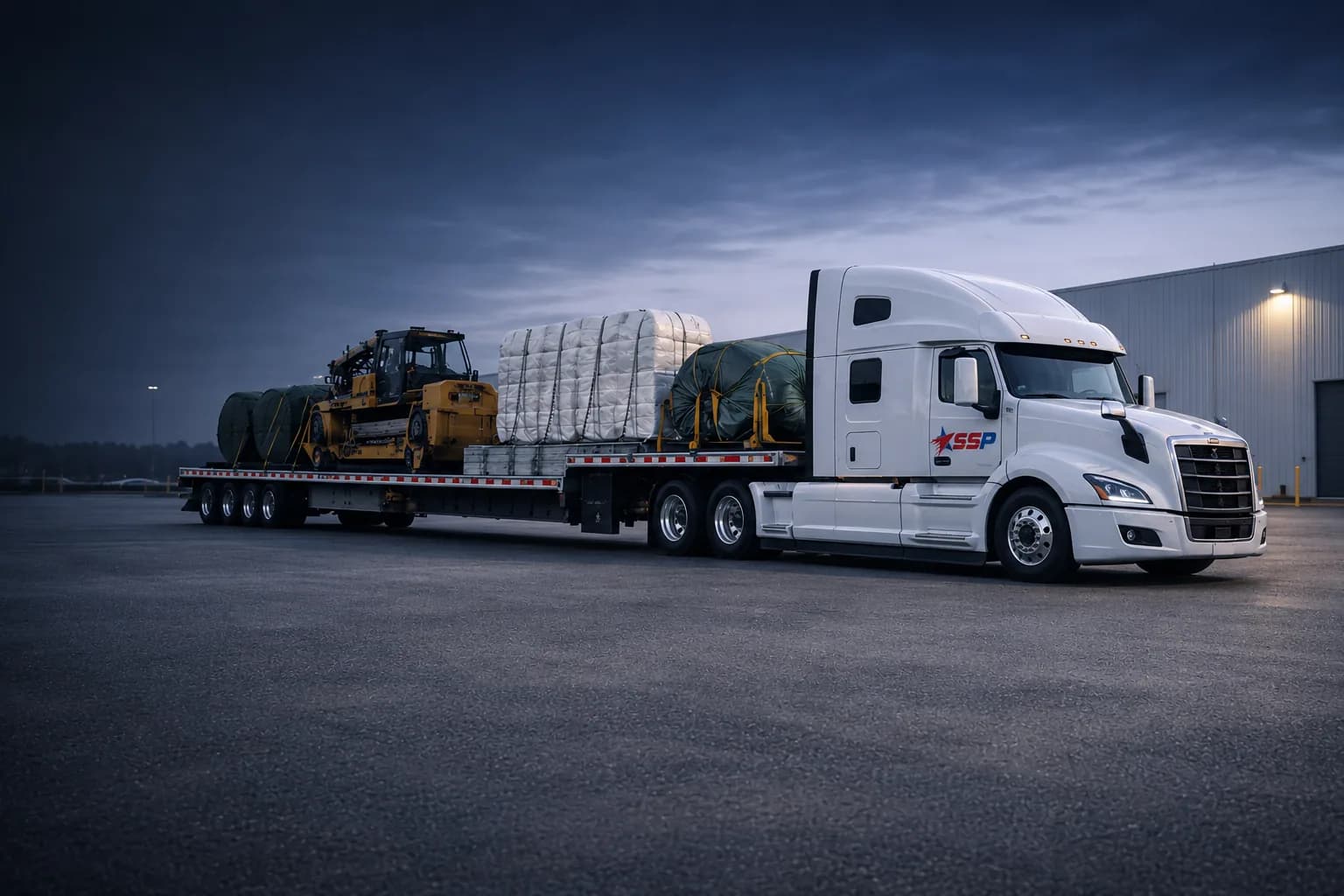
Selecting the right trailer is one of the most important decisions in freight transportation. The trailer you choose directly impacts shipping costs, transit efficiency, loading accessibility, and regulatory compliance. Two of the most commonly used open-deck trailers are flatbed trailers and step deck trailers.
While both options provide flexibility for transporting oversized and heavy freight, they serve different purposes. Understanding their unique features can help shippers avoid unnecessary costs, reduce delays, and ensure cargo arrives safely.
This guide compares flatbed and step deck trailers, explains their advantages and limitations, and helps you determine which solution is best for your specific freight requirements.
What Is a Flatbed Trailer?
A flatbed trailer is an open-deck trailer with no roof, sides, or rear enclosure. Its simple design allows cargo to be loaded and unloaded from virtually any angle using cranes, forklifts, or other lifting equipment.
Standard flatbed trailers are typically 48 to 53 feet long and 102 inches wide, making them one of the most versatile trailer types in the transportation industry.
Common Freight Transported on Flatbeds
- Steel coils and beams
- Lumber and building materials
- Pipes and tubing
- Palletized freight
- Construction equipment
- Industrial machinery
- Concrete products
Advantages of Flatbed Trailers
- Easy loading and unloading from all sides
- Widely available across North America
- Often lower transportation costs
- Suitable for many freight categories
- Simplified freight securement
What Is a Step Deck Trailer?
A step deck trailer, also known as a drop deck trailer, features two deck levels: an upper deck and a lower deck. The lower deck sits closer to the ground than a standard flatbed, allowing taller cargo to be transported without exceeding legal height restrictions.
Most step deck trailers measure between 48 and 53 feet in length and provide significantly greater vertical clearance than traditional flatbeds.
Common Freight Transported on Step Decks
- Agricultural equipment
- Industrial generators
- Large compressors
- Manufacturing machinery
- Construction equipment
- Tanks and vessels
- Oversized freight requiring additional height clearance
Advantages of Step Deck Trailers
- Accommodates taller freight
- Reduces need for oversize permits
- Provides more flexibility for large equipment
- Supports a wide range of heavy industrial cargo
- Maintains many of the loading advantages of a flatbed
Flatbed vs Step Deck: Key Differences
Although these trailers appear similar, several important differences affect which option is most appropriate for a shipment.
1. Deck Height
The primary difference is deck height.
A standard flatbed deck typically sits approximately 5 feet above the ground, while a step deck's lower platform sits closer to 3.5 feet above the ground. This lower deck provides additional cargo height clearance.
2. Cargo Height Capacity
Height restrictions are often the deciding factor when choosing between these trailer types.
Flatbeds generally accommodate freight up to approximately 8.5 feet tall while remaining within common legal highway height limits. Step decks can typically transport cargo up to about 10 feet tall on the lower deck without requiring specialized permits in many situations.
For shippers transporting taller machinery or equipment, the additional clearance offered by a step deck can eliminate costly permitting requirements. For loads that exceed standard limits entirely, RGN heavy haul may be the appropriate alternative.
3. Freight Accessibility
Both trailer types offer excellent accessibility.
Flatbeds provide unrestricted access from all sides and above, making them ideal for crane loading and unloading.
Step decks offer similar accessibility but provide added flexibility when dealing with tall cargo.
4. Weight Capacity
Both trailer types are capable of hauling substantial loads.
In many standard configurations, flatbeds and step decks can accommodate freight loads approaching 48,000 pounds, depending on trailer specifications, axle configuration, and applicable regulations.
5. Cost Considerations
Flatbeds are often more readily available in the market, which can result in lower transportation costs.
Step decks may command slightly higher rates because they are more specialized and frequently used for freight requiring additional height clearance.
However, when transporting tall cargo, a step deck may ultimately save money by avoiding oversize permits, escort vehicles, route surveys, and regulatory delays. Learn more about safety and compliance considerations that can impact your trailer selection.
When Should You Use a Flatbed Trailer?
A flatbed trailer is usually the best option when freight dimensions remain within standard legal limits.
Ideal Flatbed Applications
- Lumber shipments
- Standard machinery
- Palletized industrial freight
- Equipment with moderate height profiles
Why Choose a Flatbed?
- Lower transportation costs
- Greater equipment availability
- Faster scheduling opportunities
- Simpler freight planning
If height is not a concern, a flatbed is often the most economical solution.
When Should You Use a Step Deck Trailer?
A step deck trailer becomes advantageous when freight height approaches or exceeds standard flatbed limitations.
Ideal Step Deck Applications
- Agricultural tractors
- CNC machines
- Industrial generators
- Large compressors
- Construction machinery
Why Choose a Step Deck?
- Increased legal cargo height
- Reduced permit requirements
- Improved flexibility for oversized freight
- Better fit for specialized industrial shipments
For many tall loads, a step deck offers the perfect balance between cost and capability. If you're moving loads across borders, explore our Canada-USA cross-border freight options compatible with both trailer types.
Flatbed vs Step Deck Comparison Table
| Feature | Flatbed Trailer | Step Deck Trailer |
| Deck Configuration | Single level | Upper and lower deck |
| Typical Length | 48–53 ft | 48–53 ft |
| Width | 102 in | 102 in |
| Cargo Height Capacity | Approximately 8.5 ft | Approximately 10 ft |
| Loading Access | Excellent | Excellent |
| Typical Freight | Building materials, steel, pallets | Machinery, generators, oversized equipment |
| Permit Avoidance for Tall Loads | Limited | Better |
| Availability | Very high | Moderate |
| Typical Cost | Lower | Slightly higher |
Factors to Consider Before Choosing a Trailer
Freight Dimensions
Measure cargo height, width, and length carefully before selecting a trailer.
Weight Requirements
Verify total shipment weight and axle distribution requirements.
Loading Equipment
Consider whether cranes, forklifts, or ramps will be used during loading and unloading.
Route Restrictions
Bridge clearances, road restrictions, and state regulations can impact trailer selection. Review our active freight lanes to understand route coverage and potential restrictions.
Transportation Budget
Evaluate both transportation rates and potential permit costs before making a decision.
Frequently Asked Questions
Is a step deck the same as a drop deck trailer?
Yes. The terms "step deck" and "drop deck" are commonly used interchangeably within the freight industry.
Can a step deck haul the same freight as a flatbed?
In most cases, yes. A step deck can transport many of the same freight types while also accommodating taller cargo. View our full core freight modes to see all available trailer options.
Which trailer is more affordable?
Flatbed trailers are often less expensive due to higher availability. However, step decks can reduce overall costs when transporting taller freight.
Which trailer is better for heavy machinery?
Step deck trailers are generally preferred for heavy machinery because they provide additional height clearance and improved versatility. For extremely heavy or oversized loads, consider our specialized and critical freight solutions.
Do step deck trailers require special permits?
Not necessarily. One of their primary advantages is helping freight remain within legal height limits, potentially avoiding permit requirements.
Conclusion
Both flatbed and step deck trailers play essential roles in modern freight transportation. Flatbeds are cost-effective, versatile, and ideal for standard-sized freight, while step decks excel when cargo height becomes a challenge.
If your shipment fits comfortably within standard height restrictions, a flatbed is often the most economical choice. However, if you're transporting tall equipment, industrial machinery, or oversized freight, a step deck can provide the additional clearance needed to move your load safely and efficiently.
The best choice ultimately depends on your freight dimensions, budget, route requirements, and transportation goals. By evaluating these factors carefully, you can select the trailer that delivers the best balance of cost, compliance, and operational efficiency.